
Life-force Movement (Brand) · Sep 21, 2026
How Conscious Breathing Can Transform Your Mind, Body and Emotional Wellbeing
How the simplest thing your body does can become a doorway to awareness.
Breathing is one of the few things your body does constantly without asking for your attention. You breathe while working, sleeping, speaking, walking, exercising, worrying, thinking and even dreaming. Yet most of us rarely notice it.
That is what makes the breath so interesting. Something so ordinary can become a doorway into greater awareness of the body, the mind and the way we respond to life.
When you are stressed, your breathing may become faster or more shallow. When you are frightened, your breath can change before you have consciously registered the fear. When you finally relax after a difficult day, there is often a natural sigh, a deeper exhalation or a subtle softening throughout the body.
The relationship works both ways. Our emotional and physical states can influence the breath, but deliberately paying attention to breathing can also influence how we experience those states.
Research into regulated breathing practices has found evidence of potential benefits for stress and anxiety, although researchers continue to investigate which techniques, durations and circumstances are most effective. The important point is not to treat breathing as a miracle cure, but to understand it as one practical way of developing greater awareness of our physical and emotional state.
This is where conscious breathing becomes more than simply “taking a deep breath.” It becomes a practice of paying attention.
For traditions such as Hatha Yoga, Qigong and other internal arts, the breath has long been treated as an important bridge between physical movement, attention and inner experience. Life-force Movement brings together practices such as Hatha Yoga, Qigong, Hunyuan Taiji and Tibetan breathwork as part of a broader approach to body awareness and energy cultivation.
The important point is not to force the breath. It is to become intimate with it.

The Breath You Take Without Thinking May Be Shaping Your Experience
There is a strange irony in modern life. We pay attention to almost everything except the thing that keeps us alive. We monitor our phones, our schedules, our finances, our productivity, our sleep and our food. Yet we can go through an entire day without noticing how we are breathing.
And then something stressful happens. A difficult conversation. A crowded train. A demanding meeting. An unexpected message. Suddenly, the breath changes. The chest tightens. The rhythm becomes quicker. The shoulders rise. The body prepares for action.
This does not necessarily mean something is wrong. Breathing naturally adapts to what we are doing and experiencing. The opportunity is simply to notice.
That is the beginning of conscious breathing.
Conscious breathing does not require you to sit cross-legged for an hour. It does not require advanced knowledge. It can begin with something as simple as noticing whether your breathing is rushed, comfortable, restricted, smooth or tense.
The question becomes: What is my breath doing right now?
That question can create a small but valuable pause between what is happening and how you respond.
For someone exploring a broader Life-force Movement practice, this awareness is foundational. The approach brings together movement, breathing and internal awareness as part of a progressive practice.
The breath becomes something you listen to rather than something you constantly try to manipulate. That distinction matters.
Conscious Breathing and the Mind
A busy mind rarely announces that it is becoming busy. It simply accelerates.
One thought becomes another. One concern triggers another. You replay a conversation while simultaneously planning tomorrow and worrying about something that has not happened yet. The body may be sitting still, but the mind is running.
Breathing can provide an anchor.
When attention rests on the movement of inhalation and exhalation, there is something immediate to observe. You do not have to solve anything. You do not have to understand everything. You simply notice.
Air enters. The body responds. Air leaves. The body settles. Again and again.
This does not mean conscious breathing will magically empty the mind of thoughts. That expectation often creates another form of struggle.
The practice is subtler.
You notice that a thought has appeared, and then you return to the breath. You notice tension, and you return. You notice distraction, and you return.
Over time, this can cultivate a different relationship with mental activity. Instead of automatically following every thought, you begin to recognise that attention can be redirected.
Research into slow breathing has identified changes involving autonomic and central nervous system activity, alongside reported psychological effects such as relaxation and reduced arousal in some study populations. However, this does not mean every breathing technique will produce the same result, and individual responses can vary.
This is one reason conscious breathing practice can be understood as part of a broader practice rather than an isolated technique. Breathing, posture, movement and awareness can all be explored together.
The breath is not separate from the body. And the mind is not separate from either.
The Body Knows More Than We Give It Credit For
You can often tell when someone is uncomfortable without asking them. Their jaw tightens. Their shoulders lift. Their movements become rigid. Their breathing changes.
The body speaks continuously, but modern life teaches us to ignore much of what it says.
Conscious breathing can help restore some of that conversation.
Instead of forcing the body into a particular shape, you begin noticing where movement feels restricted. Instead of automatically taking a larger breath, you notice whether the breath is already comfortable.
This is where breath awareness and mindful movement can work together.
In the Life-force Movement approach, Hatha Yoga provides a physical foundation, with attention given to movement, posture, breath and internal awareness. The practice is not simply about achieving a particular physical position. It is also about becoming more sensitive to what is happening inside the body.
That sensitivity can be useful.
When you notice that your shoulders have been tense for hours, you have information. When you realise that your breathing becomes shallow whenever you feel pressured, you have information. When you discover that your body feels different after slowing down, you have information.
You do not necessarily need to immediately fix everything you notice.
Sometimes awareness has to come before change.
Breathing and Emotional Balance
Emotions have a physical texture.
Anger may feel hot and tight. Fear can feel constricting. Sadness may feel heavy. Excitement can make the heart and breath accelerate. Anxiety can make the body feel as though something needs to happen immediately.
The breath often changes alongside these experiences. This gives conscious breathing an interesting role.
Rather than using breathing to suppress an emotion, you can use it to remain present while the emotion is happening.
That is a very different practice.
Suppose someone sends you a message that immediately irritates you. The instinct may be to respond. Conscious breathing introduces another possibility.
Pause. Feel the body. Notice the breath. Let a few natural cycles pass. Then decide what actually needs to be said.
The emotion has not necessarily disappeared. But you may have created enough space to respond rather than react.
That space is valuable.
Research reviews suggest breathing exercises may help reduce measures of stress and anxiety in some adult populations, while also noting limitations in the existing evidence and the need for stronger research.
So it is better to think of breathing as a supportive practice rather than a replacement for appropriate medical or psychological care.
The deeper lesson is simpler: you do not have to believe every feeling demands immediate action.
Sometimes you can breathe first.
From Breathing Exercise to Internal Practice
There is a difference between doing a breathing exercise and developing a relationship with the breath.
An exercise has a beginning and an end. A relationship develops through attention.
This distinction becomes especially relevant in traditional practices such as Qigong, Hunyuan Taiji and Tibetan breathwork.
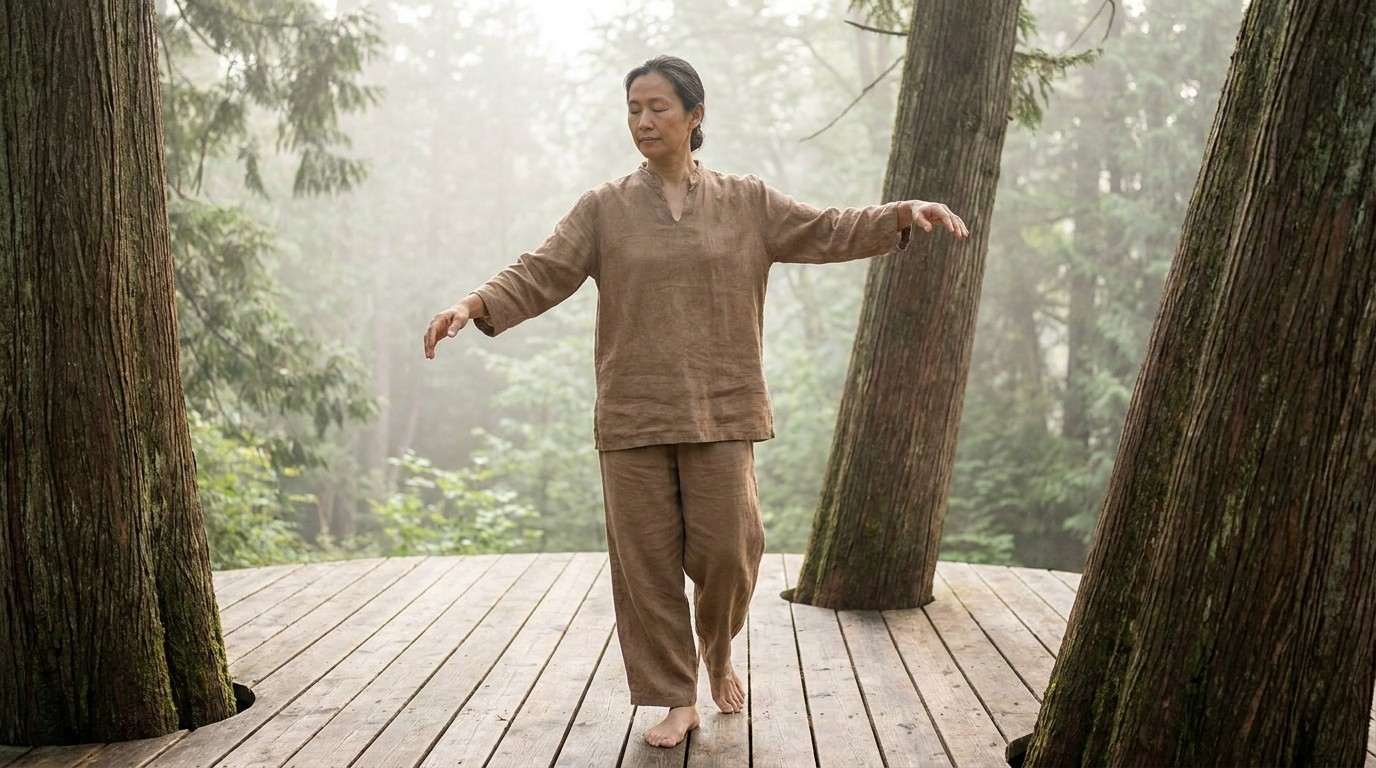
In Qigong, breathing is practiced alongside posture, slow movement and focused attention. Hunyuan Taiji similarly brings body, breath and intention together through flowing movement. These practices can be approached as forms of internal cultivation rather than simply as physical exercise.
The movements may appear simple from the outside.
But simplicity can be deceptive.
A slow movement gives you time to notice things that fast movement hides. Where is the weight? Where is the tension? Is the breath moving naturally? Can the body remain relaxed while attention stays clear?
These are not merely physical questions. They train awareness.
This is why Qigong and Hunyuan Taiji can complement conscious breathing. Movement gives the breath a physical context, while the breath gives movement another layer of awareness.
The same principle applies to broader internal arts practice, where movement, breathing and intention can be explored together.
This is why conscious breathing can become a gateway rather than a destination.
You start by noticing the breath. Then you notice the body. Then you notice the mind. Eventually, you begin noticing the relationship between all three.
Where Tibetan Breathwork Fits
Not every form of breathwork should be treated as simple relaxation breathing.
Some traditional systems use more structured techniques involving breathing patterns, attention, pauses or other elements of practice.
Tibetan breathwork is one example.
Victor Chng’s Tibetan breathwork practice presents these techniques within the broader Life-force Movement framework, with an emphasis on appropriate guidance and individual circumstances.
That point deserves attention.
More intense does not automatically mean better. More breath does not automatically mean deeper practice. And forcing the body simply because a technique looks impressive is not the same as cultivating awareness.
For beginners, the wiser starting point is often observation.
Notice your natural breath. Learn how your body responds. Build awareness gradually.
More technical breath practices are better approached with appropriate instruction rather than experimentation based on a short online video.
The aim is not to conquer the breath.
It is to understand it.
A Simple Way to Begin Conscious Breathing
You do not need complicated equipment, an expensive setup or a perfect environment to begin noticing your breath. You can start wherever you are.
Sit or stand comfortably and allow your body to settle. Instead of immediately trying to change your breathing, simply observe it. Notice whether the inhale feels comfortable and whether the exhale feels rushed. Pay attention to whether the abdomen, ribs or chest move naturally. Notice whether your shoulders, jaw or other parts of the body are carrying unnecessary tension.
Then follow one complete breath. Notice the beginning of the inhale and follow it through its natural completion. Then notice the exhale and follow that too. Continue for several breaths without trying to create a particular sensation.
If you notice tension, see whether you can soften unnecessary effort without forcing yourself to relax. If your mind wanders, simply notice that it has wandered and return your attention to the breath.
That is enough.
The practice is not about performing breathing perfectly. It is about developing the ability to notice.
With regular practice, this awareness can gradually become easier to access during ordinary situations. You may eventually find yourself noticing your breathing during a stressful conversation or before responding to a difficult situation without deliberately planning to do so.
Consistency matters more than making the practice dramatic.
Bringing the Breath Into Ordinary Life
The real test of conscious breathing is not what happens on a meditation cushion.
It is what happens when someone cuts you off in traffic. When your inbox is overflowing. When your meeting runs late. When someone says something that gets under your skin. When your body is tired but your mind refuses to slow down.
That is where practice becomes useful.
Take one conscious breath before opening an important email. Notice your breathing before an uncomfortable conversation. Pause for a few natural breaths when you feel yourself becoming reactive. Use breath awareness during a walk. Let your breathing become part of your mindful movement practice rather than something you only remember when you are stressed.
The goal is not to turn every moment into a meditation session. It is to become slightly more present inside the life you are already living.
That is a much more sustainable ambition.
From Individual Practice to Deeper Cultivation
For some people, conscious breathing remains a simple daily wellbeing practice. For others, it becomes the beginning of a deeper exploration.
That exploration may include Hatha Yoga and energy cultivation, Qigong, Hunyuan Taiji or more specialised Tibetan breathwork.
Within Life-force Movement, these practices can be explored as connected elements of a broader approach to movement, breathing and internal awareness.
This progression offers an important lesson.
You do not have to rush.
Modern culture is obsessed with acceleration. Faster workouts. Faster learning. Faster results.
Internal practice often asks for something different. Attention.
Patience.
Repetition.
Sensitivity.
The ability to stay with something long enough to notice what changes.
For practitioners who want a more immersive experience, a Life-force Movement retreat can provide dedicated time and space for movement, breathwork and internal practice away from the usual distractions of daily life.
A retreat is not necessary to develop awareness.
But stepping away from familiar routines can sometimes reveal just how much noise we have normalised.
The Quiet Power of Paying Attention
There is nothing glamorous about breathing.
It does not require an expensive device. It does not need an elaborate routine. Nobody has to know you are doing it.
And perhaps that is precisely why it has remained important across different movement, contemplative and internal traditions.
The breath is always with you.
It travels through busy days and quiet mornings. It changes when you are afraid. It changes when you laugh. It changes when you exercise. It changes when you finally feel safe enough to rest. Conscious breathing gives you an opportunity to notice those changes.
Over time, that noticing can become a form of body awareness and inner stillness. It can become part of a broader approach to energy cultivation, mindful movement and internal attention without requiring you to abandon ordinary life.
The deeper practice is not about controlling every breath. It is about becoming less unconscious inside your own experience.
Your Breath Is Already Here
You do not need to manufacture a connection between mind and body. They are already connected.
You only need to become more aware of it.
The next time you feel rushed, pause. The next time you feel emotionally charged, notice your breath before acting. The next time you sit quietly, listen to the rhythm that has been accompanying you all day.
You may discover that conscious breathing is not another task to add to an already crowded life. It is an invitation to become present inside the life you already have.
Perhaps that is where its real value lies.
Not in chasing extraordinary experiences. Not in forcing the breath into something it is not. Not in searching for a quick fix.
But in learning to listen.
One breath.
Then another.
Then another.
That is where practice begins.
Tags: Life-force Movement · Conscious Breathing · Breathwork · Qigong · Emotional Wellbeing · Mindful Movement · Singapore
Begin with a single breath
Explore how Life-force Movement brings together conscious breathing, movement and energy cultivation.
Explore services More articles