
Life-force Movement (Brand) · Oct 27, 2026
What Is Life-force Energy - and Why Should You Care?
What life-force energy means across traditions, and why paying attention to it can change how you live.
The word energy is everywhere.
We talk about having energy for work, feeling drained after a difficult conversation, regaining our energy after a good night's sleep and losing our energy when life becomes overwhelming. We recognize these experiences because they are part of everyday life. Yet when traditional practices introduce the idea of life-force energy, the conversation becomes more complicated. What exactly does it mean? Is it something we can feel? Is it a spiritual concept, a physical experience or simply another way of describing vitality?
These are reasonable questions, especially in a world where health advice often mixes ancient traditions, personal experiences and scientific terminology. It is easy to dismiss the concept of life-force energy as something outdated. It is equally easy to accept extraordinary claims without asking what they actually mean. Neither approach gives us a particularly useful understanding.
Across different cultures, traditional systems have developed their own ways of describing the relationship between breathing, movement, attention and vitality. In practices such as Qigong, Hatha Yoga, Hunyuan Taiji and Tibetan breathwork, life-force or internal energy can form part of a broader framework for understanding human experience. The language and explanations differ between traditions, and these concepts should not automatically be treated as measurable physical substances or established scientific mechanisms.
Through Life-force Movement, these traditional ideas can be explored through practical experience, conscious breathing, movement and awareness. Rather than asking people to accept a belief without question, the invitation is to become more attentive to how they breathe, move, respond to stress and experience their own vitality.
Perhaps the most useful question is not whether life-force energy can explain everything about human health. It is what we can learn when we pay closer attention to the relationship between our bodies, our breathing and the way we live.
What is life-force energy?
Life-force energy is a traditional concept used in different cultures to describe aspects of vitality, movement and the experience of being alive. It does not have one universal definition. Different traditions explain it through their own philosophies, practices and ways of understanding the human body.
In Chinese traditions, the concept of qi is central to practices such as Qigong and Taiji. In Indian traditions, the concept of prana appears in discussions of breathing, yoga and vital processes. Tibetan contemplative traditions have their own frameworks connecting breath, subtle energy and the mind. Although these concepts may share certain themes, they are not interchangeable terms with identical meanings.
In everyday language, we might describe someone as full of life, unusually energetic or completely drained. These expressions capture our experience of vitality, even though they do not identify a single biological mechanism. Traditional ideas of life-force energy operate within broader cultural and philosophical systems, offering practitioners a way to interpret experiences associated with breathing, movement, concentration and bodily awareness.
It is important to distinguish these traditional frameworks from established scientific explanations. Biological energy metabolism, oxygen transport, nervous system activity and muscular function can be investigated using scientific methods. A traditional description of life-force energy should not automatically be equated with any one of these processes, nor should subjective sensations be presented as proof of an invisible energy field.
That distinction does not make the subject irrelevant. A concept can have cultural, philosophical and practical significance without needing to serve as a universal scientific explanation. The value of exploring life-force energy may lie partly in the questions it encourages us to ask about our vitality, our habits and our relationship with the body.
Why does the idea of energy matter in modern life?
Modern life makes it easy to treat the body as a machine that must keep producing. We measure working hours, exercise performance, sleep duration and daily productivity. We try to squeeze more into the same twenty-four hours, often assuming that exhaustion is simply the price of getting things done.
But our experience of vitality is more complicated than a productivity score.
You can complete every task on your list and still feel depleted. You can spend an entire day sitting at a desk and finish it feeling physically uncomfortable. You can have enough time to rest but find your mind racing through unfinished responsibilities. These experiences have different possible causes, but they remind us that health cannot be understood through output alone.
The concept of life-force energy offers a traditional lens through which to consider this broader experience. Instead of asking only how much we can accomplish, we can ask how we feel while accomplishing it. Are we moving with awareness or rushing through every activity? Are we noticing fatigue or ignoring it? Do we have a sustainable rhythm between effort and recovery?
This is where Life-force Movement becomes relevant to contemporary wellbeing. By bringing together movement, conscious breathing and energy cultivation, the practice encourages a more attentive relationship with physical and internal experience.
The goal is not to replace medical knowledge or turn every feeling of fatigue into an energy imbalance. Persistent exhaustion can have many causes, including sleep difficulties, stress, nutritional issues and medical conditions that deserve appropriate assessment. Rather, the aim is to become more observant of our daily habits and the way they influence our experience of vitality.
Sometimes, the first step towards feeling better is not another productivity technique. It is learning to recognise what is draining us in the first place.
Breath: a practical starting point for exploring life-force
Breathing is one of the most accessible ways to begin exploring the relationship between physical experience and traditional ideas of vitality. We breathe continuously, usually without thinking about it. Yet breathing can become more noticeable when we are anxious, physically active, tired or deeply relaxed.
This makes the breath an immediate point of reference. We can observe its natural rhythm, notice whether we are holding tension and become more aware of how breathing changes during different activities. These observations do not require us to accept any particular explanation of life-force energy. They simply give us a way to pay attention to an experience that is always present.
In traditional practices, breathing may be approached as more than an automatic bodily process. It can become part of a disciplined practice involving attention, posture and movement. The purpose is not necessarily to breathe more deeply or to control every inhalation. It is to develop a more conscious relationship with breathing.
Through conscious breathing practice, we can begin with something simple: sit comfortably, allow the breath to remain natural and observe a few cycles of inhalation and exhalation. Notice the sensations without trying to force a result. When attention wanders, gently return to the breath.
Some people find this practice helps them feel more settled or recognise tension earlier. Others may experience little immediate change, and that is perfectly reasonable. The experience depends on the individual and the circumstances.
The important thing is not to chase an extraordinary sensation. It is to develop familiarity with the body and the present moment. That is a practical foundation for exploring the deeper relationship between breath, movement and awareness.
Qigong: experiencing the body through movement
Many people approach movement primarily as exercise. We walk to reach a step target, lift weights to build strength or stretch to improve flexibility. These are valuable goals, but movement can also become a way of developing awareness.
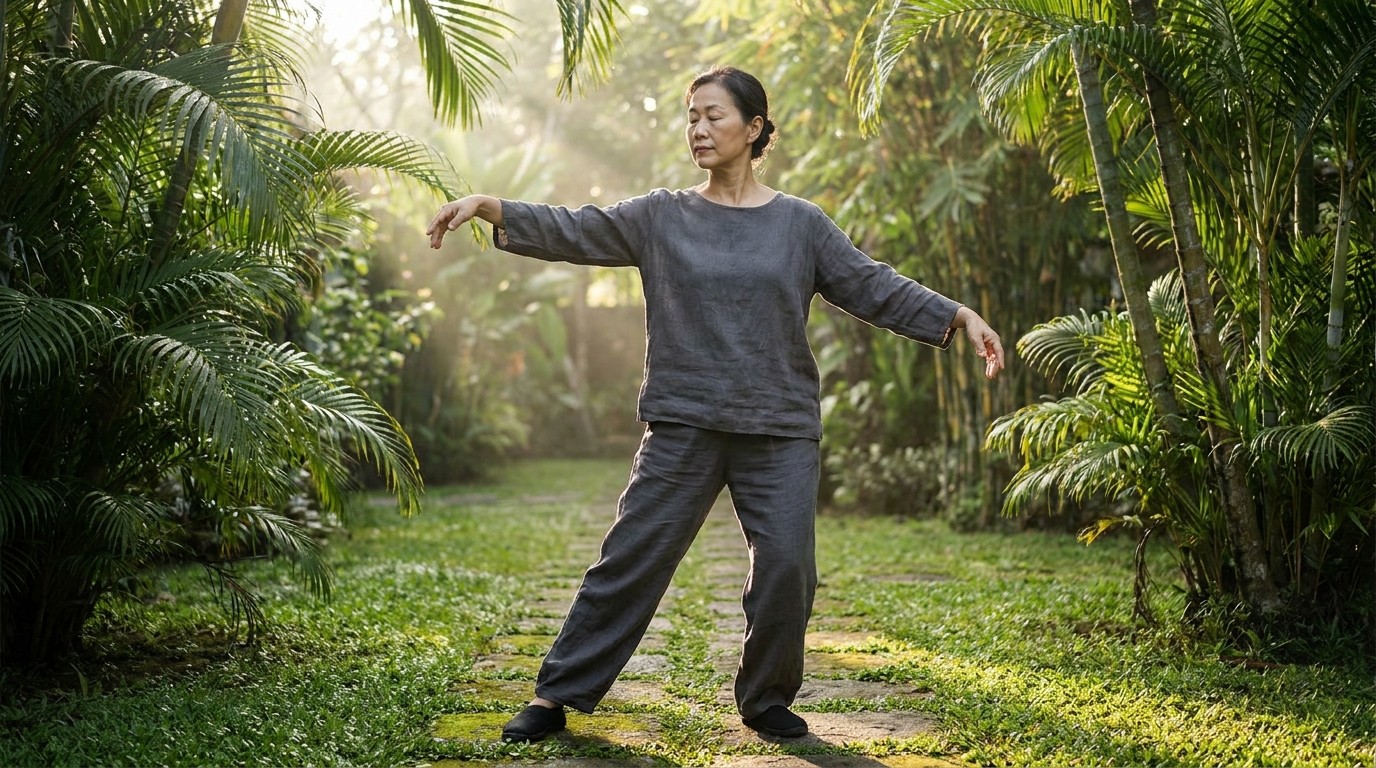
Qigong offers an approach that often combines gentle movements, standing postures, breathing and focused attention. Rather than concentrating exclusively on the amount of effort required, practitioners may explore coordination, balance, relaxation and the sensation of moving through space.
A slow movement can reveal details that might otherwise go unnoticed. We may become aware of how weight shifts between the feet, how the shoulders respond when the arms rise or how unnecessary tension affects the quality of a movement. With practice, we can begin recognizing when we are forcing an action instead of allowing it to unfold comfortably.
Within traditional Qigong frameworks, these experiences may be interpreted through the concept of qi. Practitioners sometimes describe sensations of warmth, tingling, lightness or a sense of flow. Such sensations can have different explanations and do not, by themselves, establish that a distinct form of energy is moving through the body. Their meaning within the practice can nevertheless be part of the practitioner's personal experience.
Exploring Qigong and internal arts offers an opportunity to approach movement with patience rather than constant performance pressure. The body becomes something to observe, not simply something to push.
This can be particularly useful in modern life, where much of our movement is rushed or repetitive. A deliberate practice creates space to notice how we stand, shift, breathe and coordinate our actions.
You do not need to experience unusual sensations to benefit from mindful movement. Learning to move with greater attention is already a worthwhile reason to practise.
Hatha Yoga: connecting movement, breathing and awareness
Hatha Yoga is often introduced through physical postures, flexibility and strength. These aspects can be important, but the practice can also offer a way to observe the relationship between the body, breathing and attention.
When we enter a posture, we may notice where effort is needed and where we are creating unnecessary tension. We may discover that we hold our breath when a movement becomes challenging or rush towards the final position without noticing the process. Slowing down allows us to explore these patterns more carefully.
This is one reason Hatha Yoga and foundation practice can complement an exploration of life-force energy. Rather than relying exclusively on abstract descriptions of vitality, practitioners can pay attention to direct experience: the sensation of stretching, the coordination of movement and breathing, and the difference between appropriate effort and strain.
The practice is not about forcing the body into an ideal shape. Bodies differ in mobility, strength, age and health. A useful practice respects those differences and allows movements to be adapted to individual needs.
Over time, paying attention to physical sensations can help us become more familiar with our habits. We may recognise when our shoulders are tense, when we are rushing or when we need to adjust our posture. These observations can influence how we approach movement outside a formal session.
Traditional interpretations may describe this process through ideas of internal balance or vitality. We can explore those interpretations while remaining clear about what we actually observe. We feel the movement, notice our breathing and recognise changes in comfort or concentration. We do not need to make claims beyond our experience.
Perhaps this is one of the most accessible ways to approach life-force energy: begin with the body you already have, pay attention to what you can notice and allow understanding to develop through consistent practice.
Hunyuan Taiji and the experience of flow
Life rarely remains still. Our bodies adjust constantly as we walk, reach, turn and maintain balance. Our attention shifts between different demands, and our plans change when circumstances change. Yet we often approach life as though stability means holding everything in place.
Hunyuan Taiji offers a different physical experience. Through continuous, coordinated movement, practitioners explore balance, integration and the transitions between positions. Instead of treating every movement as an isolated action, the practice encourages attention to how one position leads into another.
Within Hunyuan Taiji and internal arts practice, movement can become an exploration of how to remain grounded while adapting. The body needs enough stability to support the movement, but it also needs the ability to shift. Excessive rigidity can interfere with that process, while uncontrolled movement can make coordination difficult.
This provides a useful metaphor for everyday life. We sometimes spend considerable energy trying to control situations that are changing beyond our control. We resist adjustments because we assume that changing direction means losing our stability. Yet adaptability can be a form of strength.
The same principle can be explored in movement. Rather than forcing every transition, we learn to notice the relationship between posture, balance and direction. We become more attentive to the process instead of concentrating only on the destination.
Traditional Taiji concepts may describe aspects of practice through qi and internal integration. These ideas belong to a particular philosophical and practical context. They should not be confused with a scientifically demonstrated energy field. Their experiential value can be explored through the qualities of movement, attention and coordination that the practice develops.
Sometimes, a sense of flow begins when we stop trying to force every part of the experience.
What does it mean to cultivate energy?
The word cultivation suggests that something develops through time, attention and consistent effort. In traditional movement systems, energy cultivation is not always understood as a quick technique that produces an immediate result. It can involve developing familiarity with breathing, posture, movement, concentration and the habits that shape everyday life.
This changes the way we approach practice. Instead of asking whether a single session has produced a dramatic sensation, we can ask whether we are becoming more attentive over time. Are we noticing tension earlier? Are our movements becoming more coordinated? Can we recognise when we are pushing too hard? Are we developing a more consistent relationship with rest and physical activity?
These are practical questions that do not depend on proving a particular interpretation of internal energy.
Within Life-force Movement, energy cultivation can be explored through a combination of movement, conscious breathing and awareness. The emphasis is on learning through practice rather than chasing extraordinary experiences or accepting every traditional explanation as literal fact.
This approach also requires patience. Progress may be subtle, and experiences will differ from one person to another. Some sessions may feel comfortable and focused. Others may be distracted or physically awkward. Neither experience needs to become a dramatic judgement about personal ability.
Cultivation is not a competition.
The point is to establish a practice that supports greater awareness of the body and a more considered relationship with daily life. When approached in this way, the idea of life-force energy becomes an invitation to explore, observe and learn rather than something that must be believed without question.
Life-force energy and emotional balance
People often describe emotional experiences through the language of energy. A difficult conversation leaves us drained. A meaningful interaction lifts our spirits. A demanding week makes everything feel heavier, while a peaceful walk may help us feel refreshed.
These expressions are familiar because our emotional experiences influence how we feel in the body. Stress can be accompanied by tension, changes in breathing and restlessness. Fatigue can affect concentration and patience. Excitement may make us feel more alert or ready to act. The relationships are complex, but they remind us that emotions are not experienced as abstract thoughts alone.
Traditional practices often explore these relationships through breathing, movement and attention. Rather than trying to eliminate every uncomfortable feeling, we can practise noticing what happens when emotions arise. We may recognise that our jaw tightens when we become frustrated, that our breathing changes when we feel pressured or that we rush through movements when our attention is scattered.
A conscious breathing practice can offer a brief opportunity to pause and observe these responses. Gentle movement may help us reconnect with bodily sensations after long periods of sitting or mental concentration. Neither approach guarantees emotional balance, and neither replaces professional support when distress is persistent or severe.
It is also important not to interpret every difficult emotion as evidence of an energy blockage. Sometimes the source is practical and needs a practical response: an unreasonable workload, insufficient rest, a strained relationship or a situation that requires a boundary.
The value of awareness is that it can help us distinguish between what we are feeling and what may need to change. We do not have to label every experience. We can start by noticing it, understanding its context and choosing an appropriate response.
How to explore life-force energy without chasing the extraordinary
One difficulty with the subject of life-force energy is the expectation that practice should produce something unusual. People may anticipate dramatic warmth, tingling sensations, intense emotional releases or a powerful feeling of energy moving through the body. Such experiences may be described by some practitioners, but they are not universal requirements and should not be treated as proof that a practice is working.
A more grounded approach begins with ordinary sensations.
Can you feel the contact between your feet and the floor? Can you notice how your weight shifts when you move? Can you observe your breathing without forcing it? Can you recognise unnecessary tension in the shoulders or hands? Can you remain attentive to a simple movement from beginning to end?
These questions provide a practical starting point for internal arts practice. They shift attention away from chasing a special sensation and towards developing familiarity with the body.
Start with a comfortable standing position or a gentle sequence of movements. Allow the shoulders to relax and keep the breathing natural. Move slowly enough to notice how your weight changes and how the body responds. If you become uncomfortable, dizzy or strained, stop or modify the practice. You do not need to push through discomfort to make progress.
After a few minutes, take a moment to reflect. What did you notice? Was your attention steady or distracted? Did you recognize areas of tension? Did any part of the movement feel easier when you stopped forcing it?
There are no special answers you need to produce. The purpose is to observe your experience honestly.
This is how a traditional concept can become a practical exploration without requiring exaggerated claims. We begin with what we can notice, remain open to learning and allow the practice to develop at a sustainable pace.
Making energy cultivation part of everyday life
A formal practice can be valuable, but the principles explored through movement and breathing do not have to remain confined to a training session. Everyday life provides countless opportunities to notice how we use our attention, how we move and how we respond to physical and emotional demands.
At work, we can pay attention to our posture instead of remaining in the same position for hours without a break. During a walk, we can notice the rhythm of our steps rather than looking at a screen throughout the journey. Before responding to a frustrating message, we can pause briefly and recognise how we are feeling. At the end of a demanding day, we can make room for rest rather than treating exhaustion as proof of productivity.
These actions are not magical techniques for generating internal energy. They are practical ways of becoming more aware of the habits that shape our daily experience.
For people who want a more structured approach, Life-force Movement foundation practice provides a starting point for exploring movement and conscious breathing. A regular internal arts practice can introduce further opportunities to develop coordination, balance and attention. Those who prefer a dedicated environment for learning may also explore a Life-force Movement retreat.
The best starting point is one that fits your current circumstances. You do not need to practise for hours or overhaul your routine overnight. A few minutes of comfortable movement and attentive breathing may be enough to begin establishing a habit.
Consistency matters, but so does flexibility. Your practice should support your life rather than become another source of pressure. Over time, the aim is to develop a more attentive relationship with your body, your breathing and the way you experience everyday challenges.
Life-force energy begins with paying attention
So, what is life-force energy, and why should you care?
Across traditional systems, it is a way of understanding vitality and the relationship between breathing, movement, attention and the experience of being alive. Its meanings differ across cultures, and it should not be confused with a single scientifically established substance or mechanism. Yet the practices associated with these traditions can offer a valuable opportunity to examine how we move, breathe and relate to our own experience.
You do not need to accept every traditional explanation to begin exploring the practice. You can start by noticing your breathing, paying attention to your posture, moving with greater awareness and recognizing when you need rest. You can explore Qigong, Hatha Yoga, Hunyuan Taiji or Tibetan breathwork with curiosity, respect for their traditions and a willingness to learn through consistent practice.
The deeper value may not lie in discovering an extraordinary force hidden within the body. It may lie in becoming more attentive to the life you are already living.
When we notice our habits, we have more opportunities to change them. When we recognize tension, we can respond more deliberately. When we understand the relationship between effort and recovery, we can build a more sustainable routine. And when we pay attention to our experience, we may begin to see that wellbeing involves more than constant activity or measurable performance.
This is the perspective explored through Life-force Movement: bringing together conscious breathing, movement and energy cultivation as a practical exploration of vitality and awareness.
You do not have to chase something extraordinary to begin. Start with a breath. Notice how you stand. Move with attention. Give yourself enough time to observe what changes and what does not.
To discover how Life-force Movement brings together conscious breathing, movement and energy cultivation, visit victorchng.com.
Tags: Life-force Movement · Life-force Energy · Qigong · Hatha Yoga · Hunyuan Taiji · Singapore
Begin with a breath
Discover a practice that helps you reconnect with your body, your breath and your own sense of vitality — one to one, as a corporate programme, or as a retreat.
Explore services More articles