
Life-force Movement (Brand) · Oct 12, 2026
Why Slowing Down May Be the Fastest Way to Improve Your Health
Why deliberate slowness helps us notice what our bodies actually need.
Modern life has a strange relationship with speed.
We celebrate people who get more done in less time, fill our calendars with commitments, consume information at an accelerating pace and measure progress by how quickly we reach the next milestone. Even health has become another area to optimise. We track our steps, count calories, monitor sleep and search for the most efficient exercise routines. Yet, despite all this attention to improvement, many people still feel tired, tense and disconnected from their own bodies.
Perhaps the problem is not always that we are doing too little. Perhaps we are moving through life too quickly to notice what our bodies actually need.
Slowing down is often mistaken for laziness, a lack of ambition or wasted time. In reality, slowing down deliberately can help us become more aware of our breathing, posture, movement and everyday habits. It gives us an opportunity to recognise tension before it becomes overwhelming, distinguish genuine fatigue from mental restlessness and make more considered choices about how we use our energy.
This is where Life-force Movement offers a different perspective on wellbeing. Drawing from practices such as Hatha Yoga, Qigong, Hunyuan Taiji and Tibetan breathwork, it explores the relationship between movement, conscious breathing, attention and the experience of vitality. The aim is not simply to do less. It is to become more present in what we do.
Sometimes, the fastest way to improve our relationship with health is to stop rushing long enough to understand it.
The hidden cost of always being in a hurry
Being busy has become so normal that many people no longer recognise how much tension they carry throughout the day. We move from one meeting to another, eat while answering messages, walk while looking at our phones and spend our evenings thinking about the tasks waiting for us tomorrow. Even our moments of rest can become another opportunity to consume information.
The difficulty is that the body does not always respond to our schedules in the way we expect. Long periods of sitting, insufficient movement, irregular sleep and prolonged stress can influence how we feel physically and mentally. We may notice tight shoulders, a restless mind, shallow breathing or difficulty settling down when the working day ends. These experiences can have many causes, but rushing through them without paying attention makes it harder to understand our own patterns.
The first step towards a healthier routine is not necessarily adding another task to an already crowded day. It may be recognising the habits that leave us feeling depleted. Are we rushing because something genuinely requires urgency, or have we become uncomfortable with doing anything slowly? Are we moving with purpose, or are we simply reacting to everything that demands our attention?
These questions matter because awareness gives us an opportunity to make different choices. A more conscious approach to health begins when we stop treating tiredness, tension and restlessness as inconveniences to ignore and start seeing them as experiences worth understanding.
Slowing down is not the same as doing nothing
There is an important difference between being inactive and practising deliberate slowness. Inactivity means that we are not doing much. Deliberate slowness means that we are doing something with greater attention.
A slow walk can become an opportunity to notice how the feet meet the ground, how the arms move and how breathing changes with each step. A simple stretching routine can become a way to observe areas of stiffness without forcing the body beyond its comfortable range. Even sitting quietly for a few minutes can help us recognise how often our attention jumps between unfinished tasks, imagined problems and the next notification.
This distinction is central to conscious breathing and movement. Rather than treating movement as something to complete as quickly as possible, we begin paying attention to the quality of the experience. We notice whether we are holding unnecessary tension, rushing through transitions or breathing without awareness.
The purpose is not to make every ordinary activity into a complicated mindfulness exercise. It is to rediscover the possibility of being present in activities we already perform every day.
When we slow down intentionally, we can often identify habits that would otherwise remain invisible. We may realise that we hold our breath while concentrating, tighten our shoulders when reading difficult messages or continue working even when our attention has become ineffective. These observations do not solve every problem, but they create a starting point for change.
What happens when we pay attention to our breathing?
Breathing is one of the few bodily processes that happens automatically but can also be consciously influenced. Most of the time, we hardly notice it. We breathe while working, walking, talking and sleeping. Yet when we deliberately bring attention to the breath, we gain a simple way to observe our present experience.
During a demanding day, breathing may become faster or more restricted without us consciously noticing. We may hold our breath while concentrating or find it difficult to settle when we finally have time to rest. These patterns vary from person to person, and breathing alone cannot explain every experience of stress or fatigue. Nevertheless, observing the breath can help us become more aware of how we are responding to different situations.
A simple practice is to pause for a minute or two and notice the natural rhythm of breathing. There is no need to force a deeper breath or follow an elaborate technique. Simply observe the inhalation and exhalation, allowing the breath to remain comfortable. If the mind wanders, return attention to the next breath.
This is a practical introduction to conscious breathing. The objective is not to achieve a perfect breathing pattern or produce an immediate transformation. It is to develop familiarity with an experience that is always present but often overlooked.
With regular practice, some people find that this pause helps them feel more settled or recognise tension earlier. The experience differs between individuals, so it is best approached with curiosity rather than unrealistic expectations. If a breathing exercise causes dizziness, discomfort or anxiety, return to normal breathing and stop the exercise.
The simplest practice is often the one we can return to consistently.
Qigong: learning to move without rushing
Many people associate exercise with intensity. We measure progress by the distance covered, the weight lifted, the number of repetitions completed or the amount of effort required. These measurements can be useful, but they do not represent every dimension of movement.
Qigong offers another approach.
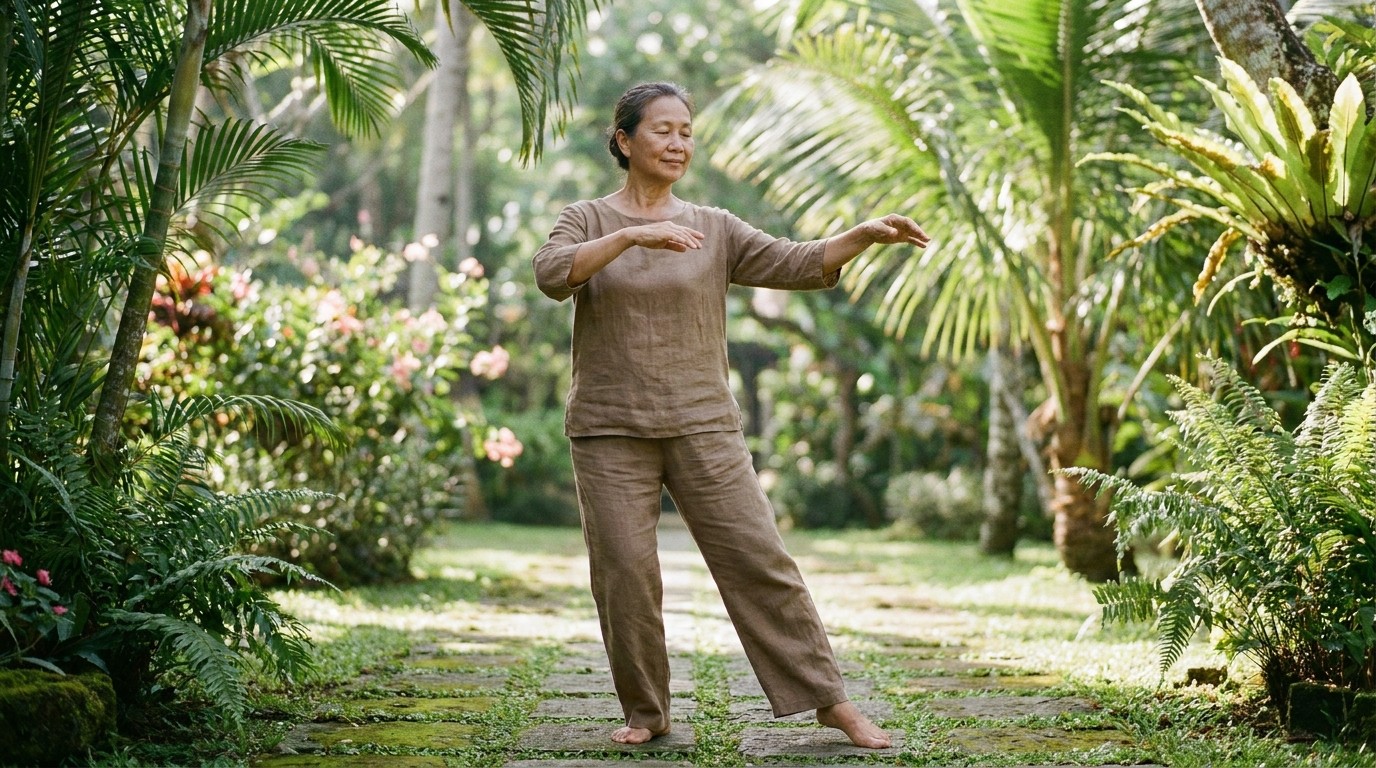
Through slow, coordinated movements, comfortable postures and attention to breathing, Qigong practice encourages practitioners to notice how the body moves as a connected whole. A shift of weight becomes something to feel rather than something to rush through. The position of the hands, the alignment of the body and the rhythm of movement become part of the practice.
Slowing down can make subtle details easier to notice. We may recognise that the shoulders are unnecessarily tense, that balance changes when we shift our weight or that we are using more effort than a movement requires. Instead of forcing the body to perform, we learn to observe and adjust.
This does not mean that slow movement should replace every form of exercise. Cardiovascular training, resistance exercise and other forms of physical activity have their own important roles. Rather, Qigong introduces an additional way to relate to movement, one that emphasises attention, coordination and the quality of the experience.
For people who spend much of their day sitting or rushing between commitments, this change of pace can offer a useful contrast. Movement becomes less about completing another task and more about reconnecting with the body.
Hatha Yoga and the value of moving with awareness
Hatha Yoga is often introduced through flexibility, physical postures and stretching. These elements can be valuable, but a more attentive approach to practice offers another dimension: the opportunity to notice the relationship between posture, breathing and concentration.
When a movement is performed too quickly, we may focus mainly on reaching the final position. When we slow down, we have more opportunity to observe how we enter and leave that position, where we feel tension and whether we are pushing beyond our comfortable limits. The experience becomes less about achieving an ideal shape and more about understanding our own physical boundaries.
This is one reason Hatha Yoga can complement a broader approach to wellbeing. It encourages a relationship with the body that does not depend entirely on external measures of performance. Flexibility and strength may develop through practice, but awareness is also part of the process.
The same principle applies outside a yoga session. We can notice how we sit at a desk, how we stand while waiting or how we carry tension in the neck and shoulders during a difficult conversation. These small observations can encourage us to adjust our habits before discomfort becomes a persistent part of the day.
Slowing down does not guarantee that pain or physical problems will disappear. Persistent or worsening symptoms may require professional assessment. But paying attention to the body can help us make more informed decisions about movement, rest and when to seek appropriate support.
The deeper lesson is simple: the body is not merely something to train. It is something to understand.
Hunyuan Taiji and finding balance without becoming rigid
Balance is often imagined as a fixed state: a position in which nothing moves and everything remains perfectly controlled. But real life rarely works that way. We adjust our posture while walking, shift our attention as circumstances change and reconsider our plans when new information appears.
Hunyuan Taiji explores a similar principle through continuous, coordinated movement. Rather than treating each position as an isolated achievement, Hunyuan Taiji and internal arts invite practitioners to explore the transitions between positions, the relationship between stability and movement, and the value of avoiding unnecessary force.
There is a useful lesson here for modern living. Constant rushing can make us reactive. We respond to the next demand before fully understanding the previous one. We become so focused on keeping everything moving that we lose sight of whether our direction still makes sense.
Slowing down creates room for adjustment. It allows us to consider whether a response is appropriate, whether a commitment needs to change or whether we are putting unnecessary effort into something that no longer serves us.
Being adaptable does not mean abandoning our responsibilities. It means responding to them with greater awareness.
Sometimes, the most effective action is not the fastest reaction. It is the response that takes the circumstances into account.
Rest is part of a healthy life, not a reward for exhaustion
Many people treat rest as something they must earn. They work until the important tasks are finished, exercise until they are completely exhausted or continue pushing through fatigue because stopping feels unproductive.
But there is always another task. There is always another message to answer, another responsibility to manage or another goal to pursue. If rest is permitted only after everything is completed, it can become indefinitely postponed.
Rest is not simply the absence of work. It is part of maintaining a sustainable relationship with physical and mental demands.
A healthier routine may involve regular sleep, appropriate physical activity, periods away from screens, meaningful social connection and time to recover between demanding tasks. These are not shortcuts or guarantees of perfect health. They are basic parts of caring for ourselves over time.
Traditional movement practices can also help us recognise that not every session needs to be intense. Some practices involve quiet standing, gentle movement, comfortable breathing or periods of stillness. The value lies partly in learning to work at an appropriate level rather than constantly pushing towards exhaustion.
A Life-force Movement practice can provide a framework for exploring these different qualities of movement and attention. The aim is not to escape responsibility, but to develop a more sustainable way of meeting it.
Recovery does not make effort meaningless. It helps make continued effort possible.
Tibetan breathwork and the discipline of attention
In a world full of competing demands, attention has become something we constantly spend. We switch between conversations, screens, notifications and unfinished tasks. Even when the day becomes quiet, the mind may continue reviewing what happened or anticipating what comes next.
Tibetan breathwork belongs to traditional practices that connect breathing with disciplined attention and contemplative training. These practices have their own cultural and philosophical contexts, and they should not be reduced to quick fixes or presented as universal solutions to modern health concerns.
One practical lesson, however, is accessible to anyone: attention can be cultivated through consistent practice.
Tibetan breathwork can be explored as part of a broader interest in how breathing, awareness and movement influence the experience of practice. The purpose is not to force the mind into complete silence. Thoughts will arise. Distractions will happen. The practice is to notice when attention has wandered and gently return to the chosen point of focus.
This simple act can be surprisingly demanding. We are accustomed to following whatever captures our attention next. Deliberately staying with one experience asks us to develop a different habit.
That habit can be relevant beyond formal practice. When we listen to someone without checking our phone, eat without scrolling through a feed or finish one task before opening another, we give our attention a clearer direction.
Slowing down does not remove every distraction. It gives us more opportunities to decide where our attention belongs.
How to bring more slowness into an ordinary day
The idea of slowing down can sound unrealistic when we already have demanding schedules. Work still needs to be done. Family responsibilities remain. Deadlines do not disappear simply because we decide to become more mindful.
The answer is not necessarily to redesign our entire lives. It is to identify small moments in which we can practise being more deliberate.
Begin with the first few minutes of the morning. Before immediately checking messages, sit comfortably and observe your natural breathing. There is no need to force the breath or achieve a particular state. Simply allow yourself a brief transition from sleep into the demands of the day.
During work, consider taking short movement breaks instead of remaining seated for long uninterrupted periods. Stand up, walk a little or gently move your shoulders and spine within a comfortable range. If possible, step away from the screen while doing so. These small breaks can make it easier to notice stiffness and interrupt long periods of inactivity.
At mealtimes, try giving at least part of your attention to the food rather than consuming it alongside a stream of messages and videos. While walking, notice your surroundings and the sensation of movement. Before moving from one task to another, pause briefly and decide what actually requires your attention next.
You could also explore a regular internal arts practice or a gentle foundation practice that incorporates movement and breathing. Start at a level that feels comfortable and choose a routine you can realistically maintain.
The key is consistency rather than complexity. A short practice that becomes part of everyday life may be more sustainable than an elaborate routine that feels like another obligation.
Why health should not become another race
The wellness industry offers an endless stream of ways to improve ourselves. New routines promise greater productivity, better sleep, improved focus, more energy and faster progress. Some approaches can be helpful, but the constant search for optimisation can also turn health into another source of pressure.
We may begin to feel that we are never doing enough. We need another supplement, another exercise plan, another breathing method or another tracking device. Even relaxation becomes something we feel compelled to perform correctly.
This is where slowing down offers a useful correction.
Health is not a competition in which the person who follows the most routines automatically wins. It is a long-term relationship with our bodies, habits, environment and responsibilities. Different people have different needs, circumstances and limitations. A routine that works well for one person may not suit another.
The traditions behind Life-force Movement encourage a more attentive way of exploring this relationship. Through movement, conscious breathing and awareness, practitioners can learn to observe their own experience rather than relying exclusively on external measures.
This does not mean abandoning medical advice, established health practices or objective measurements when they are useful. It means recognising that numbers and routines are tools, not the whole experience of being healthy.
Sometimes the better question is not, “How can I do more?”
The answer may be exercise. It may be sleep. It may be a conversation, a walk outdoors or a decision to stop working for the evening. The important thing is to make the choice with awareness rather than simply following the momentum of a busy day.
The role of consistency in long-term wellbeing
There is a reason people often abandon complicated health routines. They demand too much time, energy or motivation to remain sustainable. A practice that works only when life is calm may be difficult to maintain when work becomes demanding or personal responsibilities increase.
Slower, simpler practices can be easier to adapt because they do not always require elaborate equipment or a large block of free time. A few minutes of gentle movement, a short walk or a brief period of conscious breathing can fit into different parts of the day.
The point is not that a few minutes can replace every form of physical activity or professional healthcare. Rather, small practices can help establish a more consistent relationship with movement and awareness.
Over time, consistency creates familiarity. We become more accustomed to noticing how we feel before, during and after activity. We learn which routines fit our circumstances and which ones create unnecessary pressure. We become better at recognising when a practice needs to be adjusted.
This is also why Life-force Movement retreats may appeal to people who want dedicated time to explore movement, breathing and awareness away from ordinary distractions. A retreat is not a requirement for improving wellbeing, but a structured setting can give some people space to practise more consistently and reflect on their habits.
Ultimately, the value of a practice lies not in how impressive it looks, but in whether it helps us build a more attentive and sustainable relationship with everyday life.
Slow down to understand what your body needs
We live in a culture that often treats speed as proof of progress. We rush to finish tasks, rush to improve ourselves and rush to find solutions to the discomforts that come with modern living. Yet, when it comes to health, speed is not always the most useful measure.
Sometimes, slowing down helps us notice what we have been missing.
We notice the tension we carry while working. We become more aware of our breathing. We recognise the difference between purposeful movement and constant restlessness. We begin to understand that recovery is not a weakness and that awareness can be as important as effort.
Hatha Yoga, Qigong, Hunyuan Taiji and Tibetan breathwork offer different ways to explore these principles. Each has its own history and approach, but they can all provide opportunities to pay closer attention to movement, breathing and the experience of being present.
The objective is not to move slowly all the time. Modern life will always require periods of speed, urgency and decisive action. The goal is to develop the ability to change pace when the situation calls for it.
Move when movement is needed. Rest when recovery is needed. Breathe consciously when you need a moment to reconnect. Give your attention to the activity in front of you instead of allowing every distraction to dictate your next action.
You do not have to transform your entire life overnight. Start with one pause, one walk or one simple movement practice. Notice how you feel and build from there.
Perhaps the fastest way to improve your health is not to add more to your day.
To discover how Life-force Movement brings together conscious breathing, movement and energy cultivation, visit victorchng.com.
Tags: Life-force Movement · Health · Conscious Breathing · Mindful Movement · Qigong · Singapore
Begin with one slower pause
Discover a practice that helps you reconnect with your body, your breath and your own sense of vitality — one to one, as a corporate programme, or as a retreat.
Explore services More articles